Every session. Every tool call. Every decision. Captured from the agents your team already runs.
1Signal collects Claude Code, Codex, and Pi sessions with zero instrumentation, and turns each one into intelligence your whole team can read. Captured. Explained. Traceable.
Work that vanishes
The reasoning behind every change lives in a local terminal — until the terminal closes.
Managing by screenshot
Leads learn about agent work from status reports and pasted snippets, not from evidence.
Unprovable complaints
"The agent ignored my instructions." Maybe. Today there's no way to check.
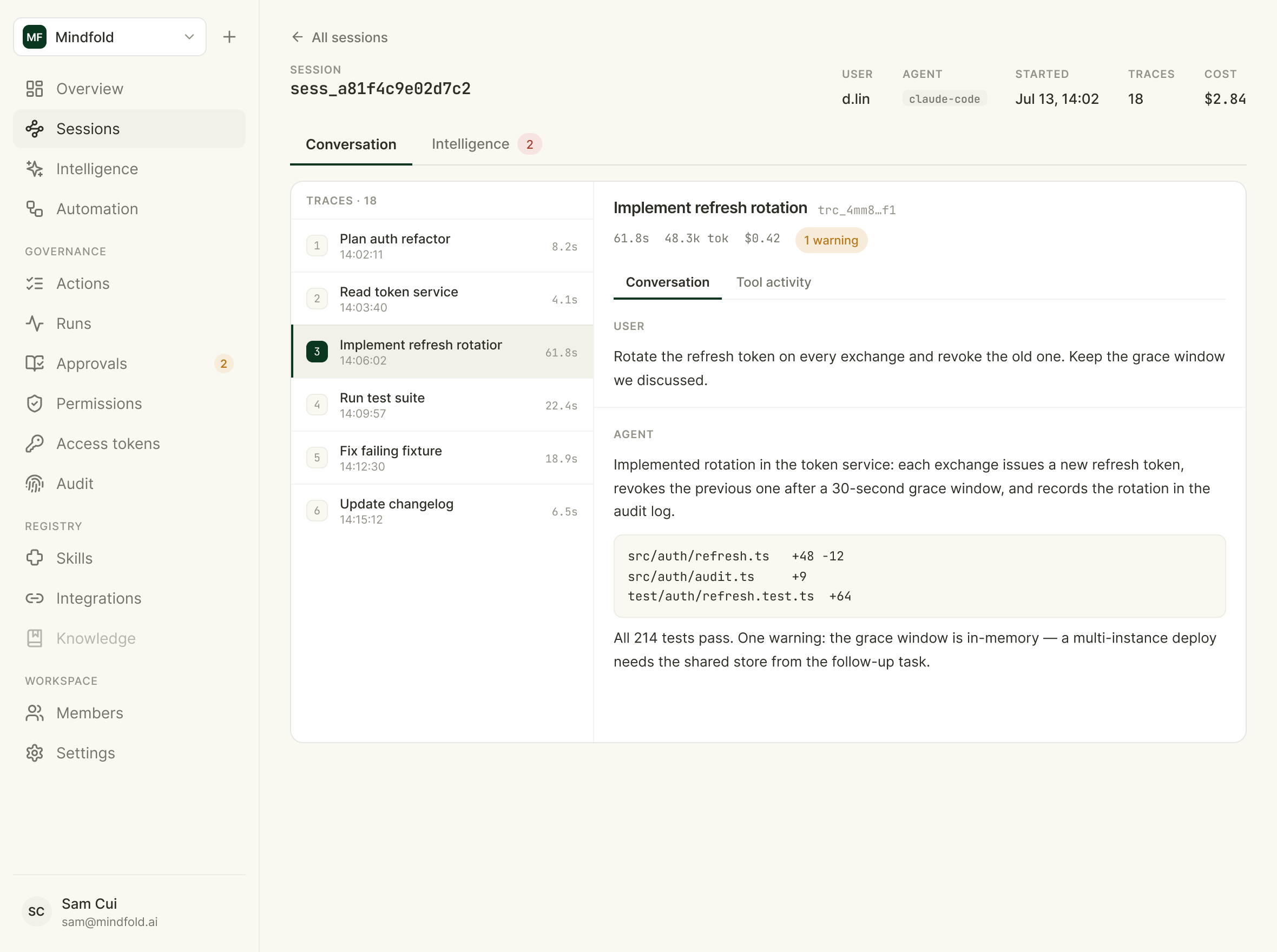
Read agent work like a conversation — not a JSON dump.
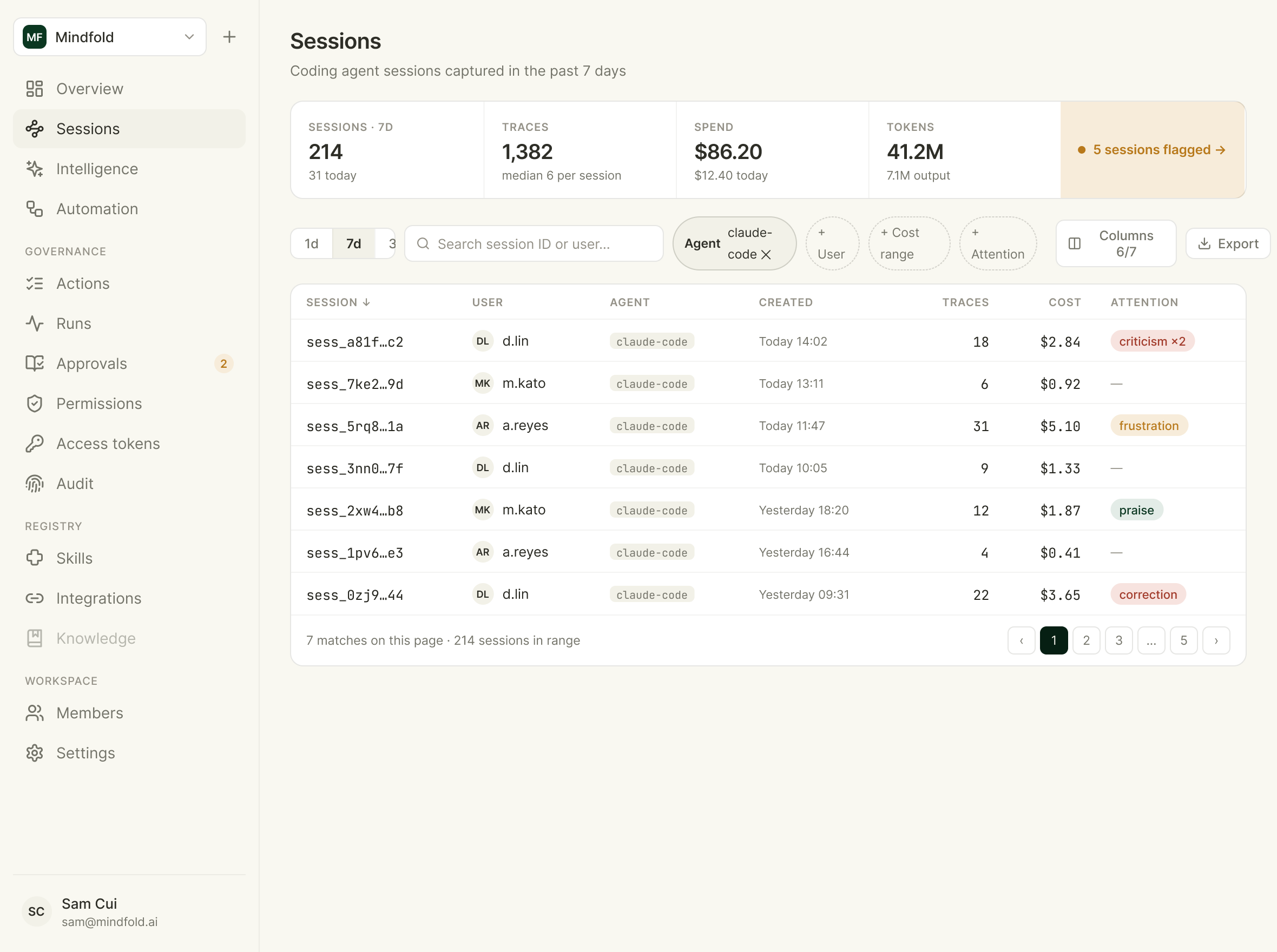
- Browse sessions by time, sorted by user, activity, or cost.
- Read user input and agent output as a conversation; see tool activity including skill and MCP usage.
- Per-turn token usage, cost, latency, errors, and event order.
- Drill from a session overview all the way down to the trace that produced a result.
When an MCP call fails, the session shows the failing step, its duration, and the error — right next to the conversation. The intelligence report links straight to that trace, so nobody re-reads a whole session to verify a conclusion.
Every session becomes an intelligence report. Every conclusion keeps its evidence.
"Did the agent follow our CLAUDE.md?"
Your plugin snapshots the AGENTS.md / CLAUDE.md that were actually in effect. 1Signal judges each applicable rule — followed violated or not observable — with source, file line, an explanation, and a link to the evidence.
"Was that complaint actually the agent's fault?"
1Signal only flags explicit, significant user feedback — and attributes it honestly: supported when the evidence is there, insufficient evidence when it isn't. An accusation is never treated as proof. Negative feedback is then tracked to addressed, unaddressed, or unclear.
"Did this session introduce risk?"
Code Risks are reported only from code changes actually captured in the session — with direct evidence. No claims about your live repo, no risk without proof.
"What was the agent even trying to do?"
Work intent — implementation, review, debugging, testing, planning, research, release — extracted with evidence snippets, alongside sampled tool, skill, and MCP activity: successes, failures, unknowns, latency.
Open any finding and land on the original turn or trace. Verify everything in context.
Analysis that runs itself.
Trigger it manually with Analyze Session.
Auto-run when a session goes quiet.
Queue instantly on a trusted session end.
Re-analyze new revisions while keeping old reports traceable.
What 1Signal won't claim.
1Signal analyzes the evidence recorded in the session — nothing else. It doesn't guess at behavior it didn't capture, and it doesn't pretend to have checked your live repository or final code state. When evidence is insufficient, it says so. If a tool tells you more than its evidence supports, it isn't intelligence — it's fiction.
Turning selected findings into improvements — with sources and evidence preserved. In design; not yet available, and we'd rather ship it right than promise it early.
Frequently asked questions
Do I need to instrument anything?
How is this different from an observability dashboard?
What exactly gets collected?
1Signal is the evidence layer of the loop.
Stop guessing. Start reading the evidence.
Be among the first to see what your agents actually do. 1Signal is launching soon.